Research Article | | Peer-Reviewed

Factors Associated with Post-vaccination Immunity Against COVID-19 in Benin

Received: 27 November 2025     Accepted: 15 December 2025     Published: 16 January 2026
Views:       Downloads:
Abstract

Introduction: Vaccination remains the primary strategy against COVID-19. However, data may not reflect actual population immunity. This study aims to determine the seroprevalence of post-vaccination immunity against COVID-19 in Benin and identify associated factors. Methods: A cross- sectional descriptive and analytical study was conducted from April to September 2023 in 21 hospital centers across Benin's twelve departments and included 3802. Post-vaccination immunity was defined by the presence of anti-SARS-CoV-2 Spike IgG antibodies and the absence of anti-NCP IgG antibodies, using the Euroimmun ELISA test. Data were analyzed using STATA software with multivariate logistics regression. Results: Seroprevalence of post-vaccination immunity was 41.56%. In multivariate analysis, factors associated with this immunity were age (adjusted OR=1.56; 95% CI [1.09-2.59]), residence within the former sanitary cordon (aOR=1.34; 95% CI [1.14-3.01]), history of hypertension/cardiovascular disease (aOR=3.25; 95% CI [1.41-4.63]), and history of diabetes (aOR=2.73; 95% CI [1.89-3.93]). Conclusion: Post-vaccination immunity is higher among vulnerable groups (elderly, comorbidities) and those in strategic urban zones, reflecting the prioritization of vaccination campaigns. Recommendations are proposed to target younger populations and rural areas to strengthen collective immunity.

Published in World Journal of Public Health (Volume 11, Issue 1)
DOI 10.11648/j.wjph.20261101.12
Page(s) 11-19
Creative Commons

This is an Open Access article, distributed under the terms of the Creative Commons Attribution 4.0 International License (http://creativecommons.org/licenses/by/4.0/), which permits unrestricted use, distribution and reproduction in any medium or format, provided the original work is properly cited.

Copyright

Copyright © The Author(s), 2026. Published by Science Publishing Group

Keywords

COVID-19, Post-vaccination Immunity, Age Comorbidities, Benin

1. Introduction
Since its emergence in late 2019, the COVID-19 pandemic caused by SARS-CoV-2 has disrupted global health systems and imposed unprecedented socio-economic challenges . While Europe and the Americas have paid a heavy price in terms of mortality, Africa has presented an epidemiological profile characterized by case fatality rates lower than initial projections . However, this apparent resilience should not obscure the active circulation of the virus or the persistent risk of new epidemic waves linked to the emergence of concerning variants . In this context, vaccination has become the central strategy of the global response to contain viral transmission and reduce the burden on hospitals .
In Benin, the national vaccination strategy was deployed as an accelerated campaign despite socio-community vaccine hesitancy . While health authorities have administrative data on the number of doses administered, these indicators remain insufficient to assess the actual protection of the population . Indeed, administrative vaccination coverage can be biased by reporting errors or loss of follow-up, and does not provide information on the actual biological response of individuals . Moreover, immunity against SARS-CoV-2 is a composite phenomenon: it can result from natural infection, vaccination, or a combination of both .
The serological distinction between these types of immunity is fundamental for guiding public health policies. Currently available vaccines, particularly those using mRNA or viral vectors, primarily target the virus's Spike (S) protein. Consequently, purely post-vaccination immunity is biologically manifested by the presence of anti-Spike IgG antibodies (Anti-Spike) in the absence of antibodies directed against the nucleocapsid (Anti-NCP), the latter being produced only in response to infection with the whole virus . This biological signature allows for the differentiation of vaccine-protected individuals from those who have contracted the disease .
Several sero- epidemiological studies have been conducted in Europe and Asia to assess virus penetration , and data specific to West Africa warrant further investigation . The few available studies have often been limited to overall seroprevalence without distinguishing the origin of immunity . However, understanding the specific determinants of post-vaccination immunity is crucial. This allows not only for evaluating the effectiveness of vaccine targeting during the pandemic, but also for identifying sociodemographic groups that have remained outside the vaccination network .
This study aims to address this knowledge gap by analyzing the seroprevalence of strictly post-vaccination immunity (Anti-S positive / Anti-NCP negative) in Benin. Using a rigorous methodology with validated ELISA tests , the objective is to identify the sociodemographic and medical factors associated with this acquired immunity, in order to provide policymakers with tangible evidence to optimize future vaccination campaigns and anticipate booster dose needs.
2. Materials and Methods
2.1. Study Design, Type and Duration
This was a cross-sectional study with descriptive and analytical aims. Data collection took place over a period of six (06) months, from April to September 2023. The study was conducted in selected hospital centers distributed across the twelve departments of Benin, ensuring national representativeness of the hospital health context.
2.2. Study Population and Sampling
The study population consisted of adults and children of all ages who had attended the hospitals identified for recruitment during the study period.
Selection criteria
Subjects meeting the following criteria were included in this study:
1). Having attended one of the hospitals involved in the study during the data collection period.
2). Having given informed consent to participate in the study (or consent from parents/legal guardians for minors).
The following were excluded from the study:
1). The subjects who refused to participate.
2). Subjects whose blood samples proved unusable in the laboratory.
3). Subjects vaccinated less than one month before the study period, in order to ensure that the measured immune response is established.
The sampling procedure was carried out in two distinct stages (two-stage sampling):
1). Sampling of health centers: a probabilistic selection using simple random sampling was carried out from the database of health facilities in each department. In total, 21 hospitals were selected across the country's 12 departments.
2). Population sampling: Within each selected center, the selection of participants was carried out by a non-probabilistic method (convenience sampling) based on the active patient roster.
At the end of the recruitment process, 3802 people were included in the study.
2.3. Data Collection
Sociodemographic and clinical data were collected via a structured questionnaire and a standardized data collection form.
The biological (serological) data were obtained by analyzing blood samples using the Euroimmun anti-SARS-CoV-2 ELISA IgG test. This enzyme-linked immunosorbent assay allows for the qualitative in vitro determination of human IgG antibodies directed against SARS-CoV-2 (serum/plasma). The kit's reliability is demonstrated by a sensitivity of 94.4% and a specificity of 98.5% .
Primary data collection involved reviewing medical records, consultation notes, and laboratory reports. For hospitalized patients, a face-to-face interview was conducted to complete the questionnaire. Outpatients were contacted by telephone to obtain their consent and administer the questionnaire.
Blood samples (EDTA or citrate tubes) were transported to the National Laboratory for Viral Hemorrhagic Fevers (LNFVH) under cold chain conditions and then stored between -80°C and 4°C before analysis. Interpretation was based on the ratio (sample OD / calibrator OD). A ratio < 0.8 is negative; between 0.8 and 1.1 is equivocal; ≥ 1.1 is positive.
2.4. Study Variables
Dependent variable
The variable of interest is post-vaccination immunity, biologically defined by the simultaneous presence of the Anti-Spike IgG antibody and the absence of the Anti-NCP IgG antibody (specific to natural infection). Anti-Spike (+) and Anti-NCP (-). The comparator group ("No Post-vaccination immunity") is defined as any participant not meeting this strict profile, including both seronegative (naïve) individuals and those with serological evidence of prior natural infection (Anti-NCP +).
Independent variables
1). Sociodemographics: Sex, age, place of residence (urban, semi-rural, rural), residence within sanitary cordon (high surveillance zone at the beginning of the pandemic), monthly income, socioeconomic level, education level, occupation, ethnicity, household size, religion, geographic department.
2). Medical history: Hypertension and cardiovascular diseases, diabetes, sickle cell disease, kidney failure.
3). Related to COVID-19: History of infection (personal or family), perception of fear (scale 0-10).
4). Declared vaccination status: Vaccinated, unvaccinated, opposed to vaccination.
2.5. Data Processing and Analysis
The statistical analysis was performed using STATA® software.
1). Descriptive analysis: Qualitative variables were described by frequencies and percentages, and quantitative variables by means and standard deviations (SD).
2). Univariate analysis: Associations between independent variables and post-vaccination immunity were tested using the Pearson's chi-square test (percentages) or the Student 's t-test (means). Statistical significance was defined as p < 0.05. No post-hoc corrections for multiple testing were applied at the univariate level.
3). Multivariate analysis: Variables with a p ≤ 0.20 in univariate analysis were included in a binary logistic regression model. The final model was obtained using a backward stepwise procedure to identify associated independent factors (adjusted ORs with 95% CI).
2.6. Ethical Considerations
The study adhered to the principles of medical ethics. Research authorization was obtained from the hospital authorities. Informed consent (written or oral) was obtained from each participant. Anonymity and data confidentiality were strictly guaranteed throughout the process.
3. Results
3.1. Seroprevalence of Post-vaccination Immunity
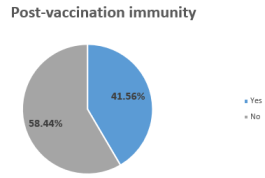
Of the 3802 participants included in the study, serological analysis revealed that 1580 individuals had an immunological profile corresponding to strict post-vaccination immunity (Anti-Spike positive and Anti-NCP negative).
Thus, the seroprevalence of post-vaccination immunity in the study population was 41.56%.
Figure 1. Seroprevalence of post-vaccination immunity.
3.2. Description of Subjects with Post-vaccination Immunity
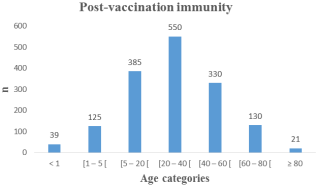
Analysis of the sociodemographic characteristics of the 1580 immunized subjects shows a female predominance (55.26%). The mean age of these subjects was 35.0 ± 18.0 years. The most represented age group was 20-40 years (34.49%), followed by 5-20 years (25.82%).
Figure 2. Distribution by age group.
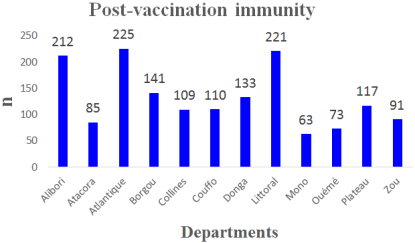
Regarding residence, 40% of immunized individuals lived in urban areas, and 80% resided outside the former sanitary cordon. The distribution of immunized individuals varied by department. The departments of Atlantique (14.24%), Littoral (13.99%), and Alibori (13.48%) had the highest proportions of immunized individuals.
Figure 3. Geographical distribution.
On a socio-economic level, the majority had a medium (35%) or low (30%) level.
Regarding medical history, among subjects with post-vaccination immunity, 30% had hypertension or cardiovascular disease, and 9% were diabetic. Concerning self-reported vaccination status, 28.73% reported being vaccinated, while 16.71% had a vaccination record confirmed by the interviewer.
3.3. Factors Associated with Post-vaccination Immunity
Table 1. Univariate analysis of sociodemographic characteristics associated with post-vaccination immunity.

Variables

Post-Vaccination Immunity, Yes (n=1580)

Post-Vaccination Immunity, No (n=2222)

p-value

Sex

0.31

Male

698 (44.2%)

1003 (45.1%)

Female

882 (55.8%)

1219 (54.9%)

Age (years)

< 0.001

Mean (SD)

38.2 ± 15.1

32.5 ± 16.9

Age Group (years)

0.002

< 1

39 (2.5%)

60 (2.7%)

1 – 4

125 (7.9%)

179 (8.1%)

5 – 19

385 (24.4%)

596 (26.8%)

20 – 39

550 (34.8%)

762 (34.3%)

40 – 59

330 (20.9%)

419 (18.9%)

60 – 79

130 (8.2%)

174 (7.8%)

≥ 80

21 (1.3%)

32 (1.4%)

Living environment

0.08

Urban

608 (38.5%)

913 (41.1%)

Semi-rural

456 (28.9%)

685 (30.8%)

Rural

516 (32.7%)

624 (28.1%)

Residence within sanitary cordon

0.002

Yes

380 (24.1%)

380 (17.1%)

No

1200 (75.9%)

1842 (82.9%)

Monthly income (CFA Francs XOF)

0.65

Refusal to answer

61 (3.9%)

87 (3.9%)

< 50,000

458 (29.0%)

645 (29.0%)

50,000 – 150,000

616 (39.0%)

867 (39.0%)

150,000 – 250,000

316 (20.0%)

444 (20.0%)

> 250,000

129 (8.2%)

179 (8.1%)

Socioeconomic level

0.51

Very low

237 (15.0%)

333 (15.0%)

Low

474 (30.0%)

667 (30.0%)

Average

553 (35.0%)

778 (35.0%)

High

237 (15.0%)

333 (15.0%)

Very high

79 (5.0%)

111 (5.0%)

Education level

0.15

Not enrolled

506 (32.0%)

711 (32.0%)

Primary

442 (28.0%)

623 (28.0%)

Secondary

395 (25.0%)

556 (25.0%)

Higher

237 (15.0%)

333 (15.0%)

Occupation

0.41

Unemployed

316 (20.0%)

444 (20.0%)

Student

237 (15.0%)

333 (15.0%)

Factory worker

253 (16.0%)

355 (16.0%)

Merchant

380 (24.1%)

532 (23.9%)

Civil Servant / Manager

394 (24.9%)

558 (25.1%)

Ethnic group

0.78

Dendi

300 (19.0%)

422 (19.0%)

Bariba

300 (19.0%)

422 (19.0%)

Fon

442 (28.0%)

623 (28.0%)

Goun

332 (21.0%)

466 (21.0%)

Other

206 (13.0%)

289 (13.0%)

Household size

0.91

≥ 5

1027 (65.0%)

1444 (65.0%)

< 5

553 (35.0%)

778 (35.0%)

Religion

0.35

Christian

695 (44.0%)

978 (44.0%)

Traditional

111 (7.0%)

155 (7.0%)

Muslim

711 (45.0%)

1000 (45.0%)

Other

63 (4.0%)

89 (4.0%)

Univariate analysis identified several factors potentially associated with post-vaccination immunity. Regarding sociodemographic characteristics (Table 1), the mean age was significantly higher in immunized subjects (38.2 years) compared to non-immunized subjects (32.5 years) (p< 0.001). Age group was significantly associated, particularly the 40-60 age group, as was residence within the sanitary cordon (p=0.002). Sex, education level, occupation, ethnicity, and religion were not statistically associated.
Analysis of medical history (Table 2) revealed a very strong association between post-vaccination immunity and the presence of comorbidities. Diabetes (p=0.001) and hypertension (p< 0.001) were significantly more frequent in immunized subjects.
Table 2. Univariate analysis of medical history.

Variables

Post-Vaccination Immunity, Yes (n=1580)

Post-Vaccination Immunity, No (n=2222)

p-value

Diabetes

0.001

Yes

127 (8.0%)

215 (9.7%)

No

1453 (92.0%)

2007 (90.3%)

Hypertension and other CVD

< 0.001

Yes

380 (24.1%)

761 (34.2%)

No

1200 (75.9%)

1461 (65.8%)

Sickle cell disease

0.68

Yes

79 (5.0%)

111 (5.0%)

No

1501 (95.0%)

2111 (95.0%)

Kidney failure

0.15

Yes

63 (4.0%)

89 (4.0%)

No

1517 (96.0%)

2133 (96.0%)

History of COVID-19 and geographic distribution showed no significant association with post-vaccination immunity in univariate analysis.
Multivariate analysis
After adjustment in the logistic regression model, four factors remained independently associated with post-vaccination immunity (Table 3).
Advanced age increases the risk of developing post-vaccination immunity (adjusted OR = 1.56; 95% CI [1.09–2.59]). Residence within the quarantine zone is a contributing factor (adjusted OR = 1.34; 95% CI [1.14–3.01]). Comorbidities play a major role: individuals with a history of hypertension (adjusted OR = 3.25; 95% CI [1.41–4.63]) and diabetes (adjusted OR = 2.73; 95% CI [1.89–3.93]) have a significantly higher likelihood of developing post-vaccination immunity.
Table 3. Multivariate analysis of factors associated with post-vaccination immunity.

Explanatory variables

Post-vaccination immunity

adjusted OR [95% CI]

p

Age

1.56 [1.09-2.59]

0.01

Residence within the sanitary cordon (yes)

1.34 [1.14-3.01]

0.006

History of hypertension and other CVD (yes)

3.25 [1.41-4.63]

0.000

History of diabetes (yes)

2.73 [1.89-3.93]

0.000

4. Discussion
This cross-sectional study, conducted with 3,802 participants across Benin, offers a unique perspective on the immunological status of the post-pandemic hospital population. With a post-vaccination immunity seroprevalence (defined by the exclusive presence of anti-spike antibodies) of 41.56%, our results reveal substantial vaccine-induced immune coverage, although not optimal for ensuring robust herd immunity against highly transmissible variants . This rate, higher than the simple vaccination declarations often reported in opinion polls, underscores the crucial importance of biological surveillance compared to self-reported data . Compared to regional data, this rate falls within an intermediate range compared to studies conducted in Nigeria or Togo, reflecting the ongoing efforts of Beninese health authorities despite a regional context of vaccine hesitancy .
Multivariate analysis highlighted major determinants of this immunity, foremost among them comorbidities. Our results indicate that diabetic and hypertensive subjects are respectively 2.73 and 3.25 times more likely to have post-vaccination immunity than the general population . This finding illustrates a health -seeking behavior: patients with chronic diseases, aware of their vulnerability to severe forms of COVID-19 documented by the CDC and WHO , adhered more closely to vaccination recommendations . In Benin, this adherence was reinforced by targeted communication to these at-risk populations during follow-up consultations, thus validating the effectiveness of integrating COVID-19 vaccination into the care pathway for chronically ill patients, as shown in several studies .
Age also proved to be a strong predictor (OR = 1.56). The increased prevalence of vaccine antibodies in older subjects reflects adherence to the vaccination prioritization established by the Beninese government, aligned with international guidelines . Furthermore, the observed lower rate of "strict" post-vaccination immunity (Anti-S+/Anti-NCP-) among younger individuals may be influenced by exposure patterns. Younger, healthier individuals are typically more socially active and thus more prone to natural infection. Since our study definition excludes individuals with Anti-NCP antibodies (markers of natural infection) from the "post-vaccination immunity" group, this creates a mechanical reduction in the seroprevalence of "vaccine-only" immunity in this demographic, favoring the elderly who may have shielded more effectively. However, this result should be interpreted with caution from an immunological perspective: while coverage is good, the scientific literature suggests that the humoral response (neutralizing antibody levels) tends to decline more rapidly in older adults (immunosenescence) . The qualitative presence of antibodies (positive test) does not guarantee indefinite protection against infection, justifying the need to maintain a booster dose policy for this specific age group .
Another key finding lies in the geographical disparity linked to the former sanitary cordon. Residents of this strategic zone, which encompassed the major urban economic centers (Littoral, Atlantique, Ouémé) at the beginning of the pandemic, had a significantly higher probability of being immune (OR = 1.34) . This result highlights the impact of structural and environmental determinants on health. The sanitary cordon zone benefited from a denser healthcare system, early vaccine availability, and intense media exposure to prevention messages . Conversely, rural or peripheral areas appear to have received less coverage, underscoring the challenges of territorial equity in access to public health interventions .
It is also striking to note the absence of a significant association between post-vaccination immunity and socioeconomic status or educational level in our multivariate model. Contrary to numerous observations in Western countries where social status is a strong predictor of vaccine acceptance , it appears that in Benin, risk perception (related to comorbidities) and geographical accessibility (sanitary cordon) prevailed over traditional social determinants. This could also suggest that the influence of community and religious leaders, which transcends social classes, played a key role in vaccine acceptance across all strata of society .
However, our study has inherent limitations. First, the use of non-probabilistic convenience sampling in hospital settings limits the generalizability of our results to the broader general population. Hospital attendees may have different health-seeking behaviors or underlying health conditions compared to the general community, potentially introducing selection bias . Second, the absence of a formal sample size calculation prior to recruitment means the study power was not optimized for all sub-group analyses. Furthermore, our definition of the comparator group ("No Post-vaccination immunity") is heterogeneous. It includes both immunologically naïve individuals and those with markers of prior natural infection (Anti-NCP positive). This introduces a potential confounding factor, as the "non-immune" group is not strictly a "non-exposed" group. Consequently, our study specifically assesses "vaccine-only" immunity and does not capture the full scope of protection provided by hybrid immunity (vaccination plus infection), which recent literature suggests may offer robust protection . Additionally, the definition of the comparator group (which includes both naïve and naturally infected subjects) introduces a potential confounding factor regarding exposure risk, as discussed above. Finally, due to the cross-sectional design and lack of data on the "time since vaccination," we could not assess antibody waning kinetics or correlate seropositivity with the duration of protection. .
5. Conclusion
This study highlights a post-vaccination immunity seroprevalence of 41.6% among the population consulting at hospitals in Benin in 2023. The main determinants of this immunity are advanced age, residence in strategic urban areas, and the presence of comorbidities. These results indicate that the strategy of prioritizing vulnerable individuals has been successful in terms of immunization coverage.
6. Recommendations
Future vaccination strategies should specifically target younger populations and rural areas to bridge the immunity gap. Booster doses should be maintained for at-risk groups (elderly, comorbidities) given the waning of humoral immunity. Surveillance systems should integrate hybrid immunity monitoring to provide a more comprehensive picture of population protection.
Abbreviations

CVD

Cardiovascular Diseases

EDTA

Ethylenediaminetetraacetic Acid

ELISA

Enzyme-Linked Immunosorbent Assay

IgG

Immunoglobulin G

NLVHF

National Laboratory for Viral Hemorrhagic Fevers

NCP

Nucleocapsid Protein

OD

Optical Density

SARS-CoV-2

Severe Acute Respiratory Syndrome Coronavirus 2

WHO

World Health Organization

Conflicts of Interest
The authors declare no conflicts of interest.
References
[1] World Health Organization. COVID-19 Weekly Epidemiological Update. Geneva: WHO; 2020.
[2] Lawal, Y. Africa's low COVID-19 mortality rate: A paradox? International Journal of Infectious Diseases. 2021, 102, 118-122.
[3] Nkengasong, J. N., Mankoula, W. LOOMING THREAT: COVID-19 in Africa. Acta Scientific Microbiology. 2020, 3(6), 01-02.
[4] Fontanet, A., Cauchemez, S. COVID-19 herd immunity: Where are we? Nature Reviews Immunology. 2020, 20(10), 583-584.
[5] Adelakun, O. COVID-19 Vaccination in West Africa: Challenges and Prospects. Pan African Medical Journal. 2021, 38, 15.
[6] Ministry of Health of Benin. COVID-19 Situation Report. Cotonou: MS; 2022.
[7] Krammer, F. SARS-CoV-2 vaccines in development. Nature. 2020, 586(7830), 516-527.
[8] To, K. K., Tsang, O. T., Leung, W. S., et al. Temporal profiles of viral load in posterior oropharyngeal saliva samples and serum antibody responses during infection by SARS-CoV-2: an observational cohort study. The Lancet Infectious Diseases. 2020, 20(5), 565-574.
[9] Riou, C., Jasson, T. Distinct antibody responses to SARS-CoV-2 in children and adults across the COVID-19 clinical spectrum. Science Immunology. 2021, 6(57), eabd4250.
[10] Ward, H., Cooke, G. Prevalence of antibody positivity to SARS-CoV-2 following the first peak of infection in England: REACT2. The Lancet. 2021, 397(10273), 477-484.
[11] Pollán, M., Pérez-Gómez, B., Pastor-Barriuso, R., et al. Prevalence of SARS-CoV-2 in Spain (ENE-COVID): a nationwide, population-based seroepidemiological study. The Lancet. 2020, 396(10250), 535-544.
[12] Mulenga, L. B. SARS-CoV-2 seroprevalence in Zambia: a cross-sectional study. The Lancet Global Health. 2021, 9(6), e773-e781.
[13] Wiysonge, C. S. Vaccine hesitancy in Africa. The Lancet Global Health. 2022, 10(2), e154-e155.
[14] Afolabi, M. O., Wariri, O. Pandemic fatigue and the new waves of COVID-19 in Africa. Pan African Medical Journal. 2021, 38, 18.
[15] Euroimmun. Anti-SARS-CoV-2 ELISA (IgG) Instruction for use. Lübeck: Euroimmun AG; 2020.
[16] Salyer, S. J. The first and second waves of the COVID-19 pandemic in Africa: a cross-sectional study. The Lancet Planetary Health. 2021, 5(3), e110-e120.
[17] Oleribe, O. O. COVID-19 pandemic in West Africa. Pan African Medical Journal. 2020, 35, 121.
[18] Ekum, A. M. COVID-19 seroprevalence in Nigeria. International Journal of Infectious Diseases. 2022, 116, S48.
[19] Halatoko, W. A. Seroprevalence of SARS-CoV-2 in Togo. Lomé Médical. 2022.
[20] Palacios, R. Phase 3 trial of a COVID-19 vaccine. New England Journal of Medicine. 2021, 385(1), 1-12.
[21] CDC. Underlying Medical Conditions and Severe Illness Among Adults. 2021.
[22] WHO Africa. Deployment of COVID-19 vaccines: guidelines for Africa. Brazzaville: WHO; 2021.
[23] Ditekemena, J. D. COVID-19 vaccine acceptance in the Democratic Republic of Congo: a cross-sectional survey. Vaccines. 2021, 9(2), 153.
[24] Haas, E. J. Impact and effectiveness of mRNA BNT162b2 vaccine against SARS-CoV-2 infections and COVID-19 cases, hospitalisations, and deaths following a nationwide vaccination campaign in Israel. The Lancet. 2021, 397(10287), 1819-1829.
[25] Bernal, J. L. Effectiveness of Covid-19 Vaccines against the B.1.617.2 (Delta) Variant. New England Journal of Medicine. 2021, 385(7), 585-594.
[26] Koffi, A. Vaccination strategies in Benin: progress report. Public Health. 2022.
[27] Bajema, K. L. Effectiveness of COVID-19 mRNA Vaccines Against COVID-19–Associated Hospitalization Among Immunocompromised Adults. Morbidity and Mortality Weekly Report. 2021, 70(43), 1500-1505.
[28] Levin, E. G. Waning Immune Humoral Response to BNT162b2 Covid-19 Vaccine over 6 Months. New England Journal of Medicine. 2021, 385(24), e84.
[29] Naaber, P. Dynamics of antibody response to BNT162b2 vaccine after six months: a longitudinal prospective study. The Lancet Regional Health - Europe. 2021, 10, 100208.
[30] Hounnankan, A. Management of the COVID-19 pandemic in Benin: the sanitary cordon. Benin Médical. 2020.
[31] Kpozehouen, A. Knowledge, attitudes, and practices regarding COVID-19 in Benin: A cross-sectional study. PLOS ONE. 2020, 15(11), e0242503.
[32] Badoum, G. Acceptance of COVID-19 vaccination in West Africa. Vaccinated. 2022.
[33] Lazarus, J. V. A global survey of potential acceptance of a COVID-19 vaccine. Nature Medicine. 2021, 27(2), 225-228.
[34] Malik, A. A. Determinants of COVID-19 vaccine acceptance in the US. EClinicalMedicine. 2020, 26, 100495.
[35] Paul, E. Attitudes towards vaccines and intention to vaccinate against COVID-19: Implications for public health communications. The Lancet Regional Health - Europe. 2021, 1, 100007.
[36] Gouda, Z. Impact of community leaders on vaccination in Benin. African Journal of Reproductive Health. 2023, 27(5), 45-52.
[37] Togun, T. Challenges in COVID-19 research in Africa. The Lancet Respiratory Medicine. 2020, 8(11), 1073-1074.
[38] Crotty, S. Hybrid Immunity. Science. 2021, 372(6549), 1392-1393.
[39] Nordstrom, P. Risk of SARS-CoV-2 reinfection and COVID-19 hospitalisation in individuals with natural and hybrid immunity: a retrospective, total population cohort study in Sweden. The Lancet Infectious Diseases. 2022, 22(6), 781-790.
[40] Dan, J. M. Immunological memory to SARS-CoV-2 assessed for up to 8 months after infection. Science. 2021, 371(6529), eabf4063.
Cite This Article
  • APA Style

    Padonou, S. G. R., Adegbite, R., Kaucley, L., Kpossi, C., Gnanvi, M., et al. (2026). Factors Associated with Post-vaccination Immunity Against COVID-19 in Benin. World Journal of Public Health, 11(1), 11-19. https://doi.org/10.11648/j.wjph.20261101.12

    Copy | Download

    ACS Style

    Padonou, S. G. R.; Adegbite, R.; Kaucley, L.; Kpossi, C.; Gnanvi, M., et al. Factors Associated with Post-vaccination Immunity Against COVID-19 in Benin. World J. Public Health 2026, 11(1), 11-19. doi: 10.11648/j.wjph.20261101.12

    Copy | Download

    AMA Style

    Padonou SGR, Adegbite R, Kaucley L, Kpossi C, Gnanvi M, et al. Factors Associated with Post-vaccination Immunity Against COVID-19 in Benin. World J Public Health. 2026;11(1):11-19. doi: 10.11648/j.wjph.20261101.12

    Copy | Download

  • @article{10.11648/j.wjph.20261101.12,
      author = {Setondji Geraud Romeo Padonou and Romeo Adegbite and Landry Kaucley and Clotaire Kpossi and Mariane Gnanvi and Merveille Aniambossou and Leila Djagaly and Rilwane Yessoufou and Badirou Aguemon},
      title = {Factors Associated with Post-vaccination Immunity Against COVID-19 in Benin},
      journal = {World Journal of Public Health},
      volume = {11},
      number = {1},
      pages = {11-19},
      doi = {10.11648/j.wjph.20261101.12},
      url = {https://doi.org/10.11648/j.wjph.20261101.12},
      eprint = {https://article.sciencepublishinggroup.com/pdf/10.11648.j.wjph.20261101.12},
      abstract = {Introduction: Vaccination remains the primary strategy against COVID-19. However, data may not reflect actual population immunity. This study aims to determine the seroprevalence of post-vaccination immunity against COVID-19 in Benin and identify associated factors. Methods: A cross- sectional descriptive and analytical study was conducted from April to September 2023 in 21 hospital centers across Benin's twelve departments and included 3802. Post-vaccination immunity was defined by the presence of anti-SARS-CoV-2 Spike IgG antibodies and the absence of anti-NCP IgG antibodies, using the Euroimmun ELISA test. Data were analyzed using STATA software with multivariate logistics regression. Results: Seroprevalence of post-vaccination immunity was 41.56%. In multivariate analysis, factors associated with this immunity were age (adjusted OR=1.56; 95% CI [1.09-2.59]), residence within the former sanitary cordon (aOR=1.34; 95% CI [1.14-3.01]), history of hypertension/cardiovascular disease (aOR=3.25; 95% CI [1.41-4.63]), and history of diabetes (aOR=2.73; 95% CI [1.89-3.93]). Conclusion: Post-vaccination immunity is higher among vulnerable groups (elderly, comorbidities) and those in strategic urban zones, reflecting the prioritization of vaccination campaigns. Recommendations are proposed to target younger populations and rural areas to strengthen collective immunity.},
     year = {2026}
    }
    

    Copy | Download

  • TY  - JOUR
    T1  - Factors Associated with Post-vaccination Immunity Against COVID-19 in Benin
    AU  - Setondji Geraud Romeo Padonou
    AU  - Romeo Adegbite
    AU  - Landry Kaucley
    AU  - Clotaire Kpossi
    AU  - Mariane Gnanvi
    AU  - Merveille Aniambossou
    AU  - Leila Djagaly
    AU  - Rilwane Yessoufou
    AU  - Badirou Aguemon
    Y1  - 2026/01/16
    PY  - 2026
    N1  - https://doi.org/10.11648/j.wjph.20261101.12
    DO  - 10.11648/j.wjph.20261101.12
    T2  - World Journal of Public Health
    JF  - World Journal of Public Health
    JO  - World Journal of Public Health
    SP  - 11
    EP  - 19
    PB  - Science Publishing Group
    SN  - 2637-6059
    UR  - https://doi.org/10.11648/j.wjph.20261101.12
    AB  - Introduction: Vaccination remains the primary strategy against COVID-19. However, data may not reflect actual population immunity. This study aims to determine the seroprevalence of post-vaccination immunity against COVID-19 in Benin and identify associated factors. Methods: A cross- sectional descriptive and analytical study was conducted from April to September 2023 in 21 hospital centers across Benin's twelve departments and included 3802. Post-vaccination immunity was defined by the presence of anti-SARS-CoV-2 Spike IgG antibodies and the absence of anti-NCP IgG antibodies, using the Euroimmun ELISA test. Data were analyzed using STATA software with multivariate logistics regression. Results: Seroprevalence of post-vaccination immunity was 41.56%. In multivariate analysis, factors associated with this immunity were age (adjusted OR=1.56; 95% CI [1.09-2.59]), residence within the former sanitary cordon (aOR=1.34; 95% CI [1.14-3.01]), history of hypertension/cardiovascular disease (aOR=3.25; 95% CI [1.41-4.63]), and history of diabetes (aOR=2.73; 95% CI [1.89-3.93]). Conclusion: Post-vaccination immunity is higher among vulnerable groups (elderly, comorbidities) and those in strategic urban zones, reflecting the prioritization of vaccination campaigns. Recommendations are proposed to target younger populations and rural areas to strengthen collective immunity.
    VL  - 11
    IS  - 1
    ER  - 

    Copy | Download

Author Information
  • Department of Public Health, University of Abomey-Calavi, Cotonou, Benin

  • Department of Infectious Diseases, Lambarene Medical Research Center, Lambarene, Gabon

  • Ministry of Health, Cotonou, Benin

  • Faculty of Health Sciences, University of Abomey-Calavi, Cotonou, Benin

  • Faculty of Health Sciences, University of Abomey-Calavi, Cotonou, Benin

  • Faculty of Health Sciences, University of Abomey-Calavi, Cotonou, Benin

  • Faculty of Health Sciences, University of Abomey-Calavi, Cotonou, Benin

  • Faculty of Health Sciences, University of Abomey-Calavi, Cotonou, Benin

  • Department of Public Health, University of Abomey-Calavi, Cotonou, Benin

  • Abstract
  • Keywords
  • Document Sections

    1. 1. Introduction
    2. 2. Materials and Methods
    3. 3. Results
    4. 4. Discussion
    5. 5. Conclusion
    6. 6. Recommendations
    Show Full Outline
  • Abbreviations
  • Conflicts of Interest
  • References
  • Cite This Article
  • Author Information
  • Table 1

    Table 1. Univariate analysis of sociodemographic characteristics associated with post-vaccination immunity.

  • Table 2

    Table 2. Univariate analysis of medical history.

  • Table 3

    Table 3. Multivariate analysis of factors associated with post-vaccination immunity.